
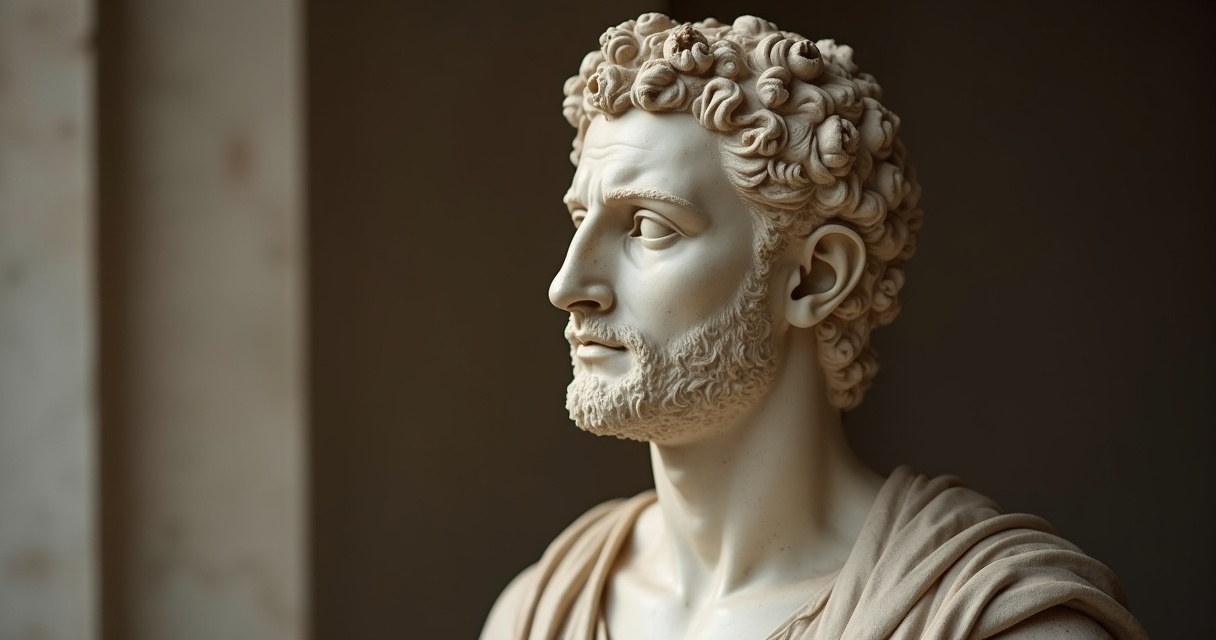

Stoicism has had an unlikely second act. A 2,000-year-old philosophy built by a freed slave (Epictetus), a Roman statesman (Seneca), and an emperor who wrote his private notebook by candlelight (Marcus Aurelius) is now quoted in NFL locker rooms, Silicon Valley founder blogs, and therapy sessions. That’s not an accident. Stoicism was never really about being unemotional — it was a practical operating system for staying steady when circumstances aren’t.
The core move the Stoics made, over and over, is a simple sorting exercise: separate what is in your control from what isn’t, and stop spending energy on the second pile. Everything else — the famous quotes, the daily journaling, the “amor fati” — is commentary on that one idea.
Table of Contents
Here are 12 sayings that hold up, with enough context to actually use them.
1. On what you can control
“You have power over your mind — not outside events. Realize this, and you will find strength.”
— Marcus Aurelius, Meditations
This is the thesis statement of the whole philosophy. Marcus wasn’t writing this for an audience — Meditations was his private journal, which is part of why it still reads as honest rather than performative. He was reminding himself, as the most powerful man in the world, that power over Rome didn’t equal power over his own reactions.
2. On disturbance vs. reality
“Men are disturbed not by things, but by the views which they take of things.”
— Epictetus
This is arguably the first formal statement of what cognitive-behavioral therapy would rediscover roughly 1,900 years later: it’s not the event that produces the emotion, it’s the interpretation layered on top of it. Same traffic jam, different person, wildly different reaction — the traffic didn’t change. This overlap with modern
psychology runs deeper than one line — see our full breakdown of the psychology of resilience.
3. On adaptability
“Change is the only thing that is permanent.”
— attributed (indirectly) to Heraclitus, Fragments
Older than the Stoics proper, but foundational to their worldview. If change is the baseline condition of reality, then resisting it is resisting reality itself — and resisting reality is a losing bet every time.
4. On self-honesty
“Be content to seem what you really are.” — Marcus Aurelius, Meditations
A quiet rebuke of the performance-self — the version of you built for an audience rather than for your own conscience. Stoic virtue was never about looking wise; it was about the private, unwitnessed choice to act well when no one’s grading you.
5. On self-mastery
“Rule yourself.”
— (A concise maxim encapsulating the ancient Greek ideal of
self-mastery, central to Socratic, Platonic, and Stoic
traditions.)
Two words, but it’s the whole tradition in miniature. The Stoics didn’t believe you could control the world. They believed, almost stubbornly, that you could control yourself — and that this was enough.
6. On resisting fear-based decisions
“Do not negotiate out of fear.”
— Inaugural Address (commonly echoed in Stoic-adjacent political rhetoric)
Fear is a terrible advisor precisely because it distorts the “sorting exercise” above — it makes external, uncontrollable threats feel like they demand your immediate compromise. Stoic practice is partly training yourself to notice fear operating and pause before it drives the decision. We cover this same fear-versus-decision-making dynamic in more depth in why courage is a daily practice, not a personality trait.
7. On habits shaping character
“Men’s natures are alike; it is their habits that carry them apart.”
— Confucius, The Analects
Not Stoic in origin, but it sits comfortably alongside the Roman Stoics’ obsession with daily practice over innate talent. None of them believed virtue was a personality trait you either had or didn’t — it was a muscle, built in the same unglamorous, repetitive way any muscle is built.
8. On seeing problems as material to work with
“Do not look at problems as stumbling blocks but as stepping-stones.”
This is Marcus Aurelius’s “the impediment to action advances action” in plainer English. Stoicism’s most practically useful move might be this reframe: an obstacle isn’t a detour from the work. Often, dealing with the obstacle is the work.
9. On virtue being sufficient
“Virtue is enough.”
— (Often associated with Stoic ethics, summarizing the idea that
virtue alone is sufficient for a good life.)
The Stoics were unusually radical here — not “virtue plus wealth plus health plus reputation equals a good life,” but virtue, full stop. Everything else was classified as an “indifferent” — nice to have, not necessary, not what your life is actually graded on.
10. On luck and effort together
“Luck and strength go together.”
A useful corrective to two overcorrected modern narratives — the “manifest it” crowd who think effort alone guarantees outcomes, and the fatalists who think outcomes are pure luck. The Stoics held both: you don’t control the dice, but you do control how well-prepared you are to use whatever number comes up.
11. On effort producing results
“Effort achieves our wishes.”
Blunt, almost annoyingly simple — and true often enough to be worth repeating. Stoic writing is full of these unglamorous little maxims that read more like a coach’s whiteboard note than “philosophy.”
12. On truth in doubt
“When in doubt, tell the truth.”
— Mark Twain, Following the Equator
Twain wasn’t a Stoic, but this line earns its place here for the same reason Stoic ethics keeps coming back to honesty: deception is expensive to maintain and cheap to abandon. Simplicity, including moral simplicity, is a kind of resilience.
How to actually use these (not just read them)
Quotes alone don’t build resilience — the Stoics were emphatic about that. Marcus Aurelius read Epictetus for years before writing a word of Meditations. The practice that made the philosophy stick was small and daily: a morning premeditation (“what might go wrong today, and is it actually in my control?”), an evening review (“where did I act well, where didn’t I”), and a running habit of noticing which pile — controllable or not — a given worry actually belongs in.
That’s most of what Enlightenso is built to do in the background: one saying a day, with enough context to actually sit with it, instead of a feed of a hundred quotes you scroll past without absorbing a single one.
FAQ
Is Stoicism about suppressing emotion? No — that’s the most common misreading. The Stoics distinguished between pathē (irrational, disturbance-driven passions) and healthy emotional responses. The goal was clear judgment, not numbness.
Where should a beginner start? Epictetus’s Enchiridion is the shortest and most direct entry point. Marcus Aurelius’s Meditations is more personal and fragmentary — better as a second read, once the framework from Epictetus is in place.
Is Stoicism compatible with religious belief? Largely yes. Stoicism is a framework for how to act and interpret events, not a theology, which is part of why it’s been adopted comfortably by people across very different faith backgrounds (and none).
Enlightenso sends one piece of timeless wisdom a day — with the history, context, and interpretation behind it, not just the quote. Try the app or get one thought in
your inbox each morning via The Daily Anchor.