
Table of Contents
The Origins: Descartes’ Search for Certainty
René Descartes wanted certainty. In the seventeenth century, he noticed that many beliefs he had accepted as true turned out to be false. So he used a method of radical doubt: reject anything that could possibly be doubted. Senses can deceive, memories distort, and even mathematical reasoning might be influenced by some imagined deceiver. But one thing could not be doubted. While he was doubting, he was thinking. The saying “If you think, then you are alive” captures that turning point in ordinary language. Descartes was not trying to prove life in a biological sense, but existence as a thinking self.
Unpacking the Meaning of Cogito Ergo Sum
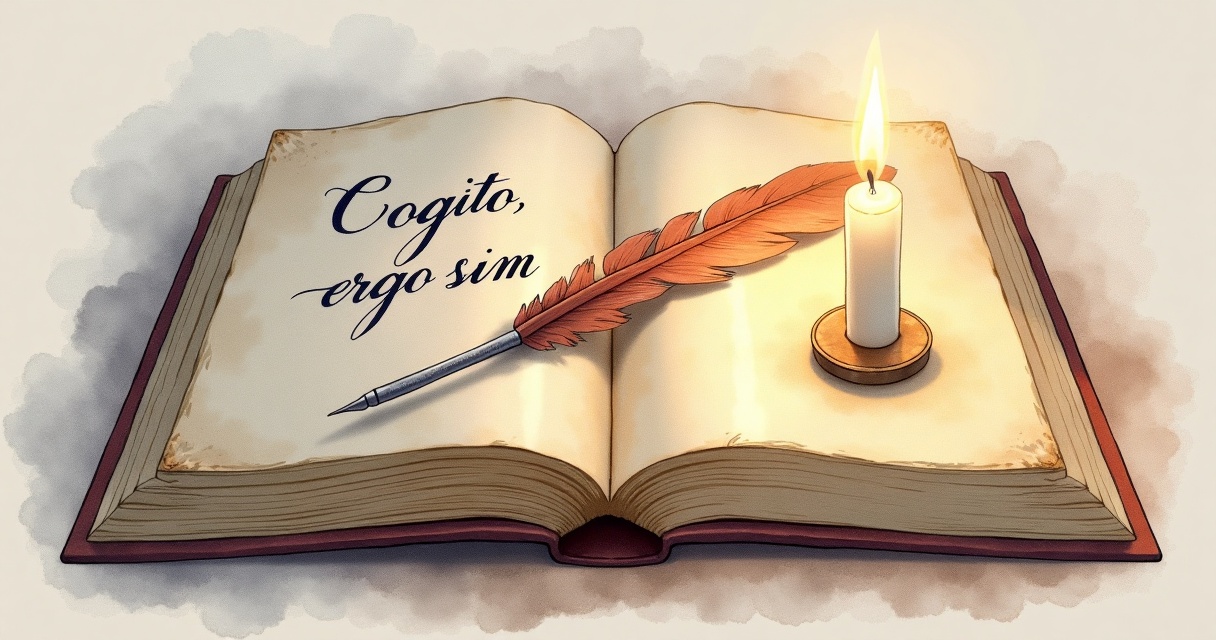
The Latin phrase is usually translated as “I think, therefore I am.” A more precise reading is “I am thinking, therefore I exist.” The distinction matters. Descartes was not claiming that a fixed “I” exists because thinking happens occasionally. He was saying that in the very act of thought, existence is undeniable. Doubt, reason, imagination, memory, confusion: all of these are forms of thinking. As long as any mental activity is occurring, there is someone doing it. The phrase is less a logical argument than an immediate experience. You cannot think yourself out of existing, because the attempt to doubt your existence still requires a thinker.
Thinking as the Ultimate Proof of Life
This is where “If you think, then you are alive” becomes useful. Many signs of being alive are external: heartbeat, movement, speech. But Descartes places the proof inside. The inner stream of questions, memories, and choices shows that you are not merely a body or an object. Even when the body is still or the outer world is uncertain, awareness remains. That inner activity is not a side effect of life added later. It is life showing up as consciousness. When people feel invisible or stuck, the simple recognition “I notice this” restores a sense of presence. Thought is not everything, but it is an undeniable sign of being.
Cogito Meaning: Beyond the Mind
The cogito is often mistaken for cold rationalism. People hear “I think, therefore I am” and assume that only logic counts. But the Latin word cogito covers more than calculation. It includes willing, doubting, hoping, perceiving, and feeling uncertain. The point is not that thinking is superior to emotion, but that no mental act can occur without a subject. This insight also connects to independent thought. When Descartes refused to accept inherited opinion as truth, he modeled intellectual courage. He was not rejecting others. He was asking what he could honestly verify. That posture matters when social pressure feels overwhelming. To think for yourself, as explored in the wisdom of independent thought, begins with noticing that your own perspective exists and deserves honest examination.
How to Apply Cogito Ergo Sum in Everyday Life
First, use it to interrupt rumination. If anxiety spins a story, the phrase “I am thinking about this” creates distance between you and the thought. It reminds you that a thought is an event, not the whole self. Second, use it as a checkpoint during information overload. When facts conflict, return to what you can verify. That reduces the pressure to have complete certainty before acting, a skill that matters when making decisions with incomplete information. Third, let it ground you in moments of doubt. You do not need to solve every question to know that you are present, aware, and capable of making a choice. The cogito is not permission to overthink. It is a reminder that thought is already proof of a living self.
Final Thoughts: The Living Thought
Cogito ergo sum survives because it is not a museum piece. It is an experience anyone can test right now. Pause and ask: “Am I thinking?” The question itself is an act of thought, and the answer is already present. That is the quiet revolution in Descartes’ phrase. It does not promise certainty about the world, other minds, or the future. It promises one foundation: a thinking presence that cannot be doubted away. From that foundation, you can ask harder questions about how to live and what matters, which echoes the ancient connection between virtue and happiness. The saying “If you think, then you are alive” keeps that foundation close. Awareness may not solve every problem, but it proves that a living center exists to face them.