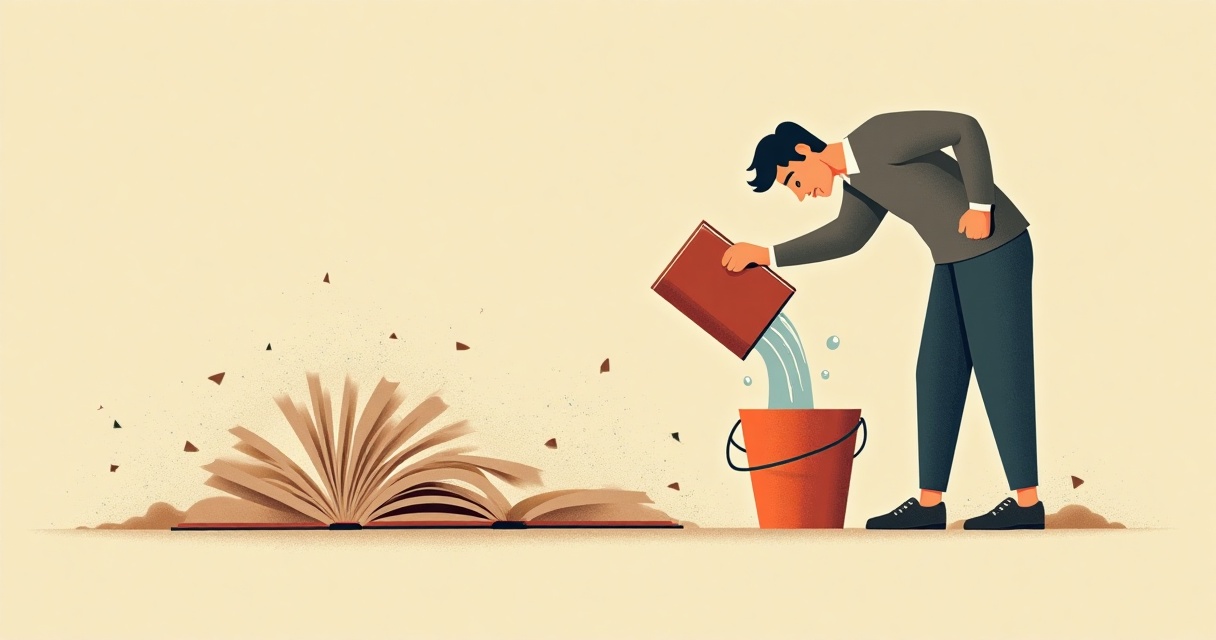

The phrase “learn nothing and forget everything” sounds like a harsh indictment—a summary of a life spent drifting without growth. It’s often used to describe people or institutions that repeat the same mistakes, fail to adapt, and lose even the hard-earned lessons of experience. But on a personal level, it points to a common modern tragedy: we consume endless information yet rarely transform it into lasting wisdom. We scroll, skim, and move on, feeling busy but never truly understanding. In a world overflowing with content, the risk isn’t ignorance—it’s the illusion of knowledge paired with rapid forgetting. This article explores why so many of us learn nothing and forget everything, and more importantly, how to break the cycle and turn daily experience into durable, life-changing insight.
Table of Contents
The Illusion of Learning: Why Exposure Isn’t Understanding
Most of us equate exposure with learning. We watch a documentary, read a self-help book, or attend a workshop and believe we’ve absorbed something valuable. But passive exposure only creates a fleeting sense of familiarity. True learning requires active engagement: asking questions, connecting new ideas to existing knowledge, and applying concepts in real situations. Without that effort, information slips into a mental junk drawer. The brain is efficient—it discards what it deems irrelevant. If you don’t consciously signal that something matters by wrestling with it, teaching it, or using it, the brain treats it as noise. That’s why you can watch ten productivity videos and still forget every tip by Friday. Learning isn’t watching; learning is doing, struggling, and reflecting.
The Forgetting Curve: How Quickly Knowledge Slips Away
German psychologist Hermann Ebbinghaus discovered something sobering in the late 19th century: we forget most new information within hours. His “forgetting curve” shows that without reinforcement, memory drops sharply—up to 70% lost within 24 hours. This isn’t a personal flaw; it’s how human memory works. The brain prioritizes survival and emotional salience, not random facts. So reading an insightful article once and never revisiting it guarantees near-total forgetting. The modern digital environment makes this worse. We’re bombarded with novel stimuli, each competing for attention, and none given time to consolidate. The result? We learn nothing and forget everything because we never schedule the spaced repetition and recall practice that moves information from short-term working memory into long-term storage.
The Role of Mindfulness in Retaining Wisdom
Mindfulness isn’t just about stress reduction—it’s a memory amplifier. When you’re fully present while learning, you encode details more richly. You notice context, emotional tone, and subtle connections. In contrast, distracted learning—half-reading while checking notifications—produces shallow, fragmented memories that fade fast. Mindfulness also helps in the moment of recall. Often we “forget” because we were never truly there in the first place. Think about a conversation where you were planning your response instead of listening. You didn’t forget what the other person said; you never learned it. By cultivating focused attention, you give every experience a fighting chance to become wisdom. Simple practices like pausing to summarize what you just read, or sitting quietly for a minute after learning, can dramatically reduce the forgetting curve.
Active Learning Strategies That Actually Work
If you want to stop the cycle of learning nothing and forgetting everything, you need to shift from passive consumption to active construction. Start by teaching what you learn. The protégé effect—explaining a concept to someone else—forces you to organize your thoughts, expose gaps, and strengthen neural pathways. You can also use the Feynman Technique: write the idea in plain language as if teaching a child. If you can’t, you haven’t truly understood it. Another powerful method is retrieval practice: close the book and write down everything you remember. This act of pulling information from memory, even with difficulty, dramatically improves retention. Finally, connect new information to old. Ask, “How does this relate to what I already know?” The more associations you build, the more retrieval routes you create. Active learning feels harder, but that’s exactly why it works.
Building a Daily Practice for Lasting Memory
Spaced repetition and consistent reflection are the antidotes to the forgetting curve. Instead of cramming information once, revisit it at increasing intervals—after a day, a week, a month. Tools like flashcards or simple journaling prompts can help, but the key is regularity. Build a daily practice of reviewing one insight from your day. Keep a wisdom journal: every evening, write down one thing you learned, one mistake you made, and one way you’ll apply it tomorrow. This tiny habit transforms experience into memory and memory into wisdom. Also, limit input. Consuming less but processing more is far more effective than consuming more and processing less. Choose quality over quantity. Read one article slowly, then write a short summary. Watch one educational video, then discuss it with a friend. The goal isn’t to know everything; it’s to deeply internalize a few things that truly matter.
From Forgetting to Flourishing: Turning Experience into Wisdom
The phrase “learn nothing and forget everything” describes a passive life—one where experience washes over us without leaving a trace. But the opposite is possible. When you actively engage with life, reflect on mistakes, and deliberately strengthen memory, you transform raw events into durable wisdom. That wisdom compounds. Each lesson becomes a foundation for better decisions, deeper relationships, and a clearer sense of purpose. You stop repeating the same errors because you remember their cost. You stop feeling stuck because you build on what you’ve learned. In a world that celebrates speed and volume, the real edge goes to those who slow down, pay attention, and remember. Don’t let your days evaporate into forgotten noise. Learn deeply, remember deliberately, and let every experience become a stepping stone rather than a blank space. That is how you move from forgetting to flourishing.